
Australia’s national environmental research infrastructure delivering billions in benefits
A new report from Lateral Economics estimates that Australia’s national…
19 October 2026With nearly 18 years' experience in the research and education sector, Paul Sherlock offers a unique perspective on the development of the eResearch landscape in Australia. Current CIO at the University of South Australia, former CAUDIT president and National Research Network project director, and long-standing member of the Australian Access Federation (AAF) Board, Sherlock has witnessed first-hand the emergence and evolution of identity federations both nationally and globally.

Reflecting on the last 10 years and the Australian eResearch environment, Sherlock said, "initially there wasn't a common understanding of the term eResearch so almost every time you used that word you had to explain what you were referring to". 10 years on, we have come a very long way and the eResearch Australasian conference, which is an important annual event for the research infrastructure community, draws more than 400 attendees from around the world.
Sherlock says AAF's critical role is simply to, "link researchers quickly and easily to the services they need, to get their research done." Kickstarting the AAF in 2009 and successfully developing it into a fully functioning and subscriber funded federation was a collaborative endeavor driven initially by the CIO community.
After a decade of hard work and dedication, the AAF continues to innovate to meet changing needs of its subscribers with enthusiasm and energy. Sherlock foresees that within another 10 years, the AAF will be, "widely recognised as the best access federation in the world." With the continued support of Australia's eResearch sector, the AAF is striving to make this vision a reality.
As Chair of the Australian eResearch Infrastructure Council from 2007 to 2013, and former QUT Deputy Vice-Chancellor (Technology, Information and Learning Support), Professor Tom Cochrane played a vital role in the establishment of the Australian Access Federation (AAF). With the support of QUT, CAUDIT and CSIRO a small amount of funding kickstarted the project that lead to the foundation of the AAF. "The AAF was the most adventurous investment. The money compared to the others was significantly less, so it was less risky for the government, said Prof Cochrane." With two previous attempts to setup a national federation, the third attempt had the smallest investment and objective to provide a self-sustaining federation, now known as the AAF.
Prof. Cochrane who compiled the 2014 Status Report on the NCRIS eResearch Capability, found that the AAF was the only capability operating as a self-sustaining entity compared to the six other eResearch infrastructure investments. Since the initial objective of authorising and enabling researchers to seamlessly access external digital services, the AAF has continued to enable national and international connectivity for Australia.
The AAF, as described in the NCRIS Report is a "service that now appears to provide the capability that everyone likes in an IT project – it just works." Evolving from a scarcely funded idea to a self-sustaining part of the Australian university landscape, the AAF is a vital national eResearch service.
In 2009, the Australian higher education landscape was severely fragmented. Student admissions were at a record high as study options broadened and university IT systems struggled to keep up with the demand. As a result, universities developed systems to provide access to digital services and staff continued to spend unnecessary time entering data manually over and over again.
Individually, universities attempted to persevere with these manual processes and identity management was proving to be complicated and ineffective. Creating and distributing an individuals credentials was a lengthy process and didn't account for sessional or invited academic roles. This whole process reflected poorly on university Identity Management systems. Former QUT Information Technology Service Director and CAUDIT President at the time, Neil Thelander confirms that the increase of systems made things "harder and harder as the number of systems grew."
After positive experiences interconnecting WiFi via eduROAM, the Council of Australasian University IT Directors (CAUDIT) agreed that a centralised access federation would be a national solution to these problems. The Australian Access Federation (AAF) would authorise staff, students and researchers around Australia, enabling them to access a wide range of digital services from many organisations. With numerous researchers already collaborating in universities this idea also piqued the interest of CSIRO, Australia's largest research organisation.
After ten years connecting people with services, "the AAF has continued to be important to research collaborations," claims Mr. Thelander. Now enabling global access for Australian researchers, the AAF is considered a crucial part of the national research infrastructure system.

A new report from Lateral Economics estimates that Australia’s national…
19 October 2026

Trusted digital access is helping researchers tackle complex challenges across disciplines and borders. A new video from Science & Technology Australia (STA) explores the role…
19 October 2026

Join the AAF at the eResearch Australasia Conference 2026, as we share insights on trust, identity and collaboration across five sessions and continue the…
18 October 2026
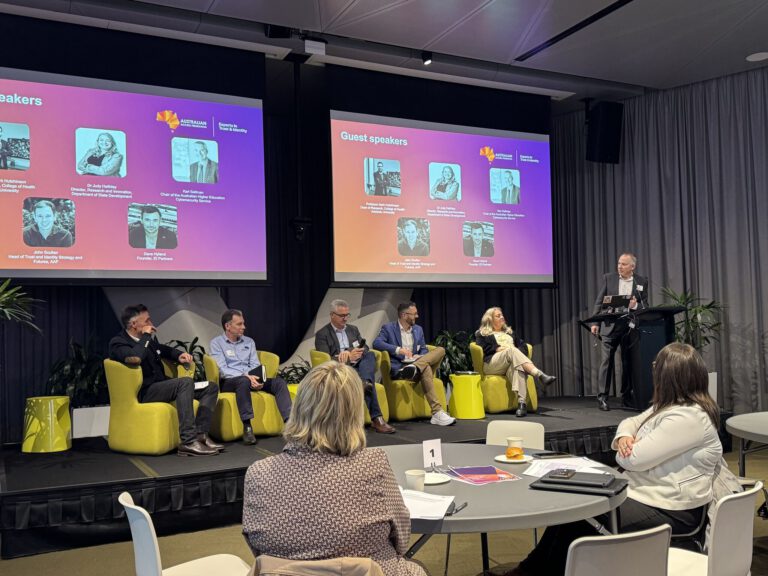
Throughout May 2026, the Australian Access Federation (AAF) brought together leaders from higher education, research, government and national research infrastructure organisations in Brisbane, Melbourne and…
6 July 2026
The AAF was proud to be a part of the NCRIS community celebrating 20 years of investment in national research infrastructure that's securing Australia's economic,…
1 July 2026
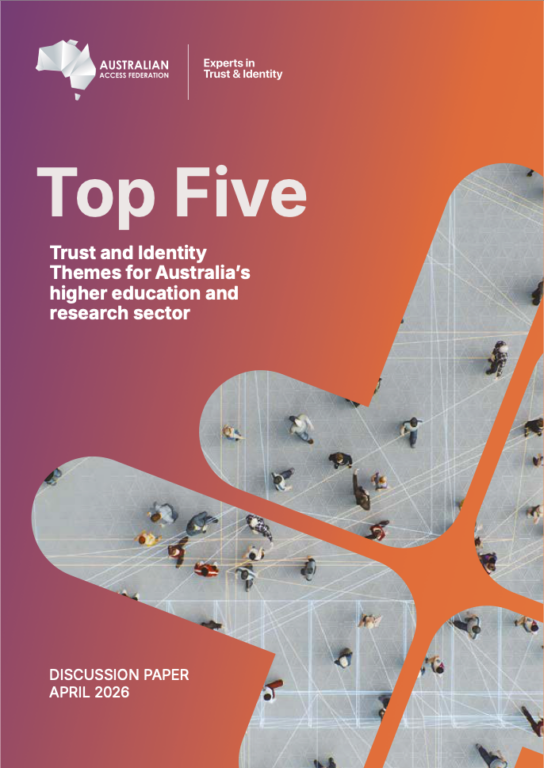
AAF's Top Five Trust and Identity Themes for Australia's Higher Education and Research Sector outlines the most critical priorities shaping this domain for sector leaders.
15 June 2026
The Australian Access Federation (AAF) welcomes the Australian Government's commitment to strengthen the delivery of a Sovereign National Trust and Identity Capability for Australia, with…
10 June 2026
For the AAF, 2025 was a significant year in our 16-year journey delivering trusted identity services for researchers, educators, students, government and industry. An…
30 April 2026

Collaboration is key in achieving high impact research outcomes, but trust and security must be in place when multiple organisations share infrastructure, data and services.
21 April 2026

The Australian Access Federation (AAF) invites you to join our state‑based Roundtable breakfast series, focused on the challenges and opportunities shaping Trust and Identity across…
7 April 2026

Communications and Engagement Officer 5 February 2026 Advance your career delivering communications and engagement activity for Australia’s leading technology expert in trust and identity for…
5 February 2026The Australian Access Federation (AAF) has become an indispensable pillar of Australia's research sector, enabling secure, seamless access and collaboration across institutions and borders. A…

4 December 2025

If you would like to discuss trust and identity for your organisation, please contact us and one of our project managers will be in contact.
Contact usSign up to our newsletter to keep up to date with news and events.