
Australia’s national environmental research infrastructure delivering billions in benefits
A new report from Lateral Economics estimates that Australia’s national…
19 October 2026Home News & Events ORCID User Story – Making life easier
Date 5 July 2022
Share
We recently chatted with Joe Shapter, the Pro-Vice-Chancellor (Research Infrastructure) at the University of Queensland (UQ), to learn more about how his ORCID ID has helped him when applying for grants.
Joe shared with AAF how his ORCID record was first registered when he was at Flinders University and it continued to be populated when he made the move to UQ. His record is set up so that it automatically populates with his research outputs as they're being released and that "it takes no effort at all – it just happens".
To make life easier, Joe publishes with a set of publishers who already have his ORCID ID, meaning he no longer needs to provide his details each time. All he does is type his name into the publishing system and up comes his ORCID ID. "It makes life so much easier", Joe claims, as he doesn't have to do anything now.
Further benefits are notable when submitting papers; "It's not only that my ORCID record is getting updated, but some of the other things that use my ORCID record are also getting updated, for example, an internal publication list at UQ". The ORCID record is populated with research outputs as they are released, allowing for others to be able to search and look at his most recent publications.
"What is critical is that my ARC record is getting updated, which is a mountainous saving of work for me and helps with keeping my CV easily up-to-date".
Joe has been applying for Australian Research Council (ARC) grants for the past 20 years and in the early days this would always require submitting documents, an updated CV and your publication record – "it was an annual process". Even if your CV was already up-to-date there "was still a pile of work to do" for example, "you might have to say what past grant funded the work or which of these papers that you're listing is related to the current application".
Since 2018, when ARC integrated their system with ORCID, Joe no longer has to go through such a time-consuming process. "It's all about populate and re-use. If I want to put in an ARC grant now and include all of my research track record, it's sitting there and ready to re-use and is being continually updated. This saved me 3-4 days per grant application – the difference in workload was staggering!"
Before using ORCID, an average application used to take a few weeks; "formatting took time, getting the publications right took many days of work". This took time away from the actual grant process. "It absolutely makes an enormous difference using my populated ORCID details". By reducing the time taken to prepare the publication part of the application, "now I've got time to deal with the other really important things such as project description and budget."
Joe also says that another benefit of having his ORCID ID integrated with funding organisations and awards is that "now there is a one-stop shop for all the funding awards I've received over the years. I can download and share my funding track record; it's readily available… and very nice to have it all in the one place."
Other researchers can also see Joe's publications, which he says has "improved my visibility without a doubt…I hope ORCID is now one of the places where people go to search for my research accomplishments."
Joe Shapter, PVC, Research Infrastructure, UQ
Having received his PhD in Reaction Dynamics from the University of Toronto in 1990, Joe subsequently held an NSERC Fellowship at The University of Western Ontario.
Joe moved to Australia in 1996 and joined Flinders University. He later served as Dean of the School of Chemical and Physical Sciences for 6.5 years. He headed involvement in both the Australian Microscopy and Microanalysis Research Facility (AMMRF) and the Australian National Fabrication Facility (ANFF) and was SA Director for AMMRF. He took up his current role at UQ in February 2018.
Joe's major interests are in the area of novel nanomaterial production, nanometer scale characterisation of these materials and their applications (e.g. sensors or solar cells).

A new report from Lateral Economics estimates that Australia’s national…
19 October 2026

Trusted digital access is helping researchers tackle complex challenges across disciplines and borders. A new video from Science & Technology Australia (STA) explores the role…
19 October 2026

Join the AAF at the eResearch Australasia Conference 2026, as we share insights on trust, identity and collaboration across five sessions and continue the…
18 October 2026
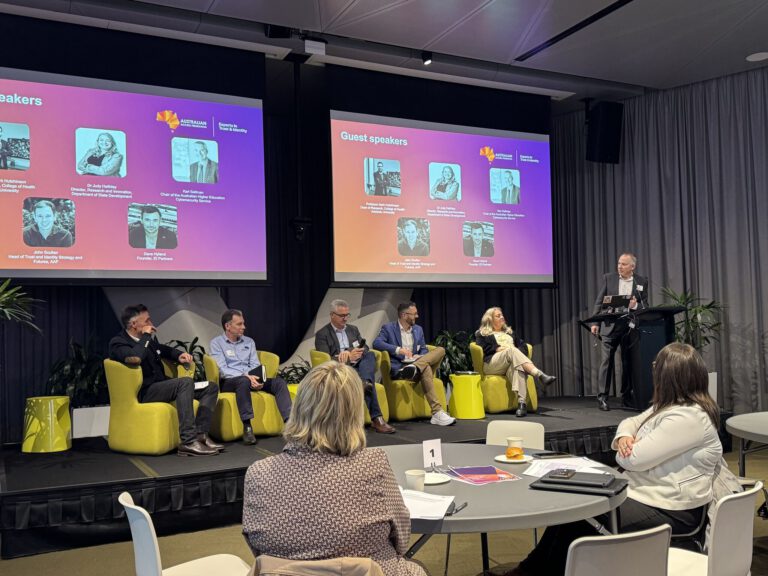
Throughout May 2026, the Australian Access Federation (AAF) brought together leaders from higher education, research, government and national research infrastructure organisations in Brisbane, Melbourne and…
6 July 2026
The AAF was proud to be a part of the NCRIS community celebrating 20 years of investment in national research infrastructure that's securing Australia's economic,…
1 July 2026
AAF's Top Five Trust and Identity Themes for Australia's Higher Education and Research Sector outlines the most critical priorities shaping this domain for sector leaders.
15 June 2026
The Australian Access Federation (AAF) welcomes the Australian Government's commitment to strengthen the delivery of a Sovereign National Trust and Identity Capability for Australia, with…
10 June 2026
For the AAF, 2025 was a significant year in our 16-year journey delivering trusted identity services for researchers, educators, students, government and industry. An…
30 April 2026

Collaboration is key in achieving high impact research outcomes, but trust and security must be in place when multiple organisations share infrastructure, data and services.
21 April 2026

The Australian Access Federation (AAF) invites you to join our state‑based Roundtable breakfast series, focused on the challenges and opportunities shaping Trust and Identity across…
7 April 2026

Communications and Engagement Officer 5 February 2026 Advance your career delivering communications and engagement activity for Australia’s leading technology expert in trust and identity for…
5 February 2026The Australian Access Federation (AAF) has become an indispensable pillar of Australia's research sector, enabling secure, seamless access and collaboration across institutions and borders. A…

4 December 2025

If you would like to discuss trust and identity for your organisation, please contact us and one of our project managers will be in contact.
Contact usSign up to our newsletter to keep up to date with news and events.