4 December 2025
Brisbane, QLD — The Australian Access Federation (AAF) has become an indispensable pillar of Australia’s research sector, enabling secure, seamless access and collaboration across institutions and borders.
A Brisbane based success story, the AAF — established in 2009 — has transformed the way Australian research operates, providing an indispensable service of trusted and secure access to 100,000s of Australian researcher and students.
Through the Federation, the AAF operates identity and access management services, that ensure that researchers across academia, industry and government can securely log in to thousands of tools, datasets, and platforms – whether they’re working from a university lab in Brisbane or a field station in Western Australia.
AAF’s services are critical in an era where research thrives on global partnerships and data-intensive projects — by providing the digital trust infrastructure that underpins these collaborations.
Why it matters for research
Modern research is increasingly collaborative, and data driven. Research in climate science, cancer, and health communities often involve multiple universities, research organisations, and international partners. AAF’s federated identity system eliminates barriers by allowing researchers, wherever they are based, to use their own credentials to access shared resources, reducing administrative overhead and accelerating discovery.
Protecting Australian research
The AAF also reduces the threat to Australian research from cyber-attacks and foreign interference, by ensuring that only trusted people have access to our valuable research and data.
The numbers behind AAF’s impact
- All public Australian universities are connected to the AAF Federation, along with major research organisations such as CSIRO, TERN Australia, Australian Research Data Commons ARDC, South Australian Health and Medical Research Institute (SAHMRI), Queensland Cybersecurity Infrastructure Foundation QCIF, and government agencies.
- The Federation now supports over 1,100 national and international services that enable teaching, learning, research, and collaboration.
- More than 1.5 million people are connected through the AAF today, including researchers, students, educators, industry and government.
- In 2025 alone, AAF enabled over 12.4 million sessions demonstrating its critical role in daily research and higher education operations.
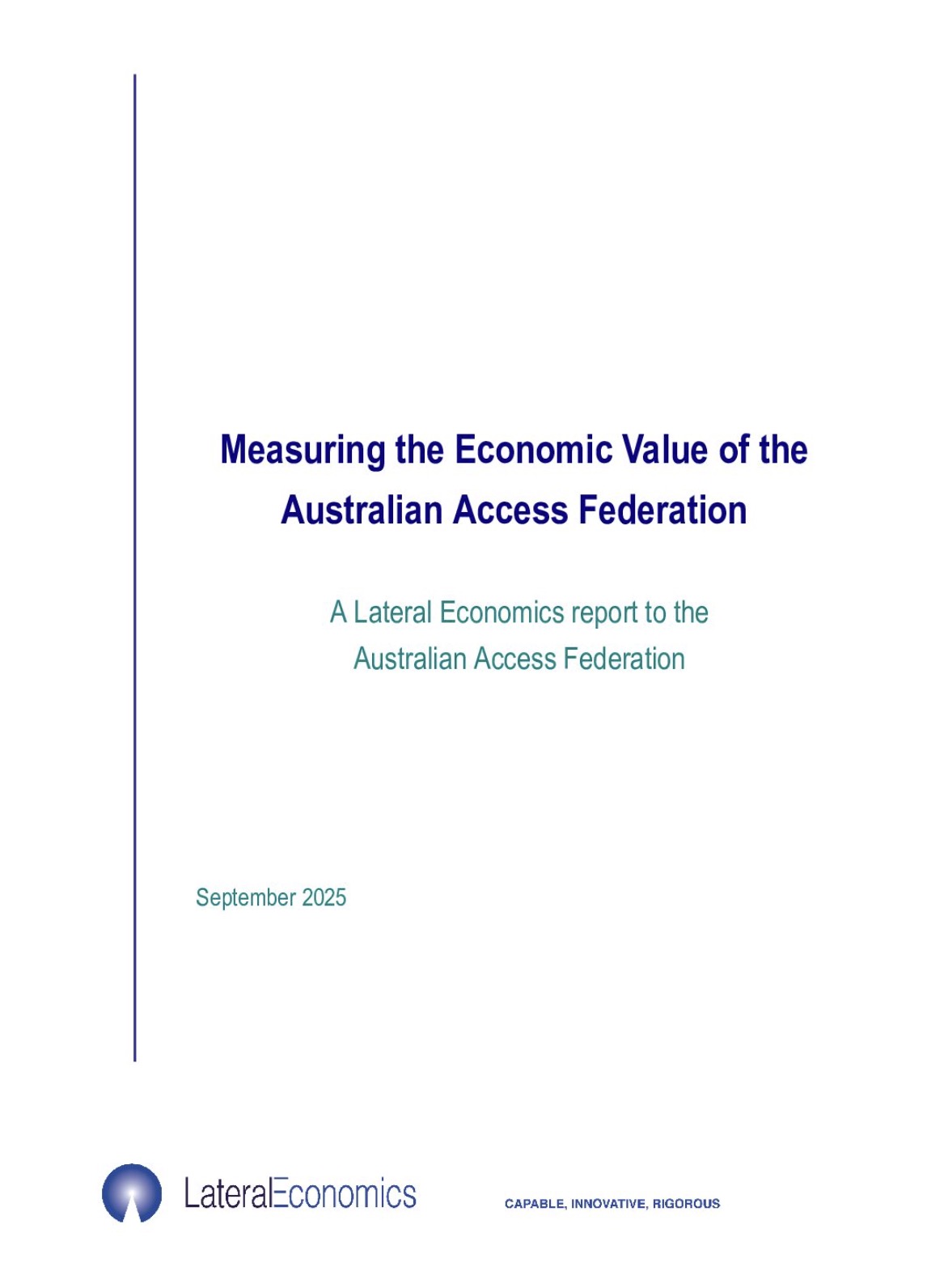
- The AAF returns benefits of up to $84 million annually, where for every dollar spent the community gains up to $12.30 in benefits.2
Major institutions connected to the AAF
The AAF connects virtually the entire higher education and research ecosystem in Australia, including the:
- Group of Eight (Go8) universities:
The University of Queensland, The University of Melbourne, The University of Sydney, The University of Western Australia, Adelaide University, The University of New South Wales, Monash University, Australian National University - Other leading universities:
Queensland University of Technology (QUT), Griffith University, RMIT University, University of Technology Sydney (UTS), University of Wollongong, Macquarie University, La Trobe University, Curtin University, Deakin University, James Cook University, Flinders University, and many more - National research infrastructures:
CSIRO, ARDC, TERN, ACCESS-NRI, Australian Antarctic Division, Australian Institute of Marine Science AIMS, ANSTO, Pawsey Supercomputing Research Centre and we’re partnering with many more as a part of the National Collaborative Research Infrastructure Strategy (NCRIS) funded Trust and Identity capability. - Medical research institutes:
QIMR Berghofer, Garvan Institute of Medical Research, Murdoch Children’s Research Institute, Walter and Eliza Hall Institute, SAHMRI (South Australian Health and Medical Research Institute). - Government:
ARC: Australian Research Council, NHMRC: National Medical Health Research Council - Other partners:
QCIF and NSW Health
Supporting national priorities
Recognised as Australia’s national capability for Trust and Identity and part funded by the National Collaborative Research Infrastructure Strategy (NCRIS), the AAF works with national research infrastructures to enable secure access to their services. This means that AAF’s services are woven into the fabric of Australia’s research sector. By removing barriers, the AAF empowers universities, research institutes, industry partners and government policy makers to focus on innovation rather than technology hurdles.
Driving global innovation and security
The AAF plays a critical role in safeguarding sensitive data. Its trust framework ensures compliance with global standards, protecting intellectual property and personal information while enabling interoperability with international Federations like eduGAIN. This makes Australian researchers’ first-class citizens in global science collaborations.
Delivering a future of collaboration and innovation
As Australia positions itself as a leader in data-intensive research, AAF’s role will only grow. With emerging technologies like AI and quantum computing demanding even greater collaboration and security, the Federation remains a cornerstone of trust and connectivity for the nation’s future research and development.
“Trust and identity underpin every aspect of modern research – it’s fundamental infrastructure that creates significant advances in outcomes for Australian researchers” AAF’s Chief Executive Officer Heath Marks.
- Data Breach Investigations Report, Verizon, 2023 >> https://www.verizon.com/business/resources/Ta5a/reports/2023-dbir-public-sector-snapshot.pdf
- Measuring the Economic Value of the Australian Access Federation, Lateral Economics, September 2025 >> https://aaf.edu.au/wp-content/uploads/Measuring-the-Economic-Value-of-the-AAF-Lateral-Economics-Report.pdf